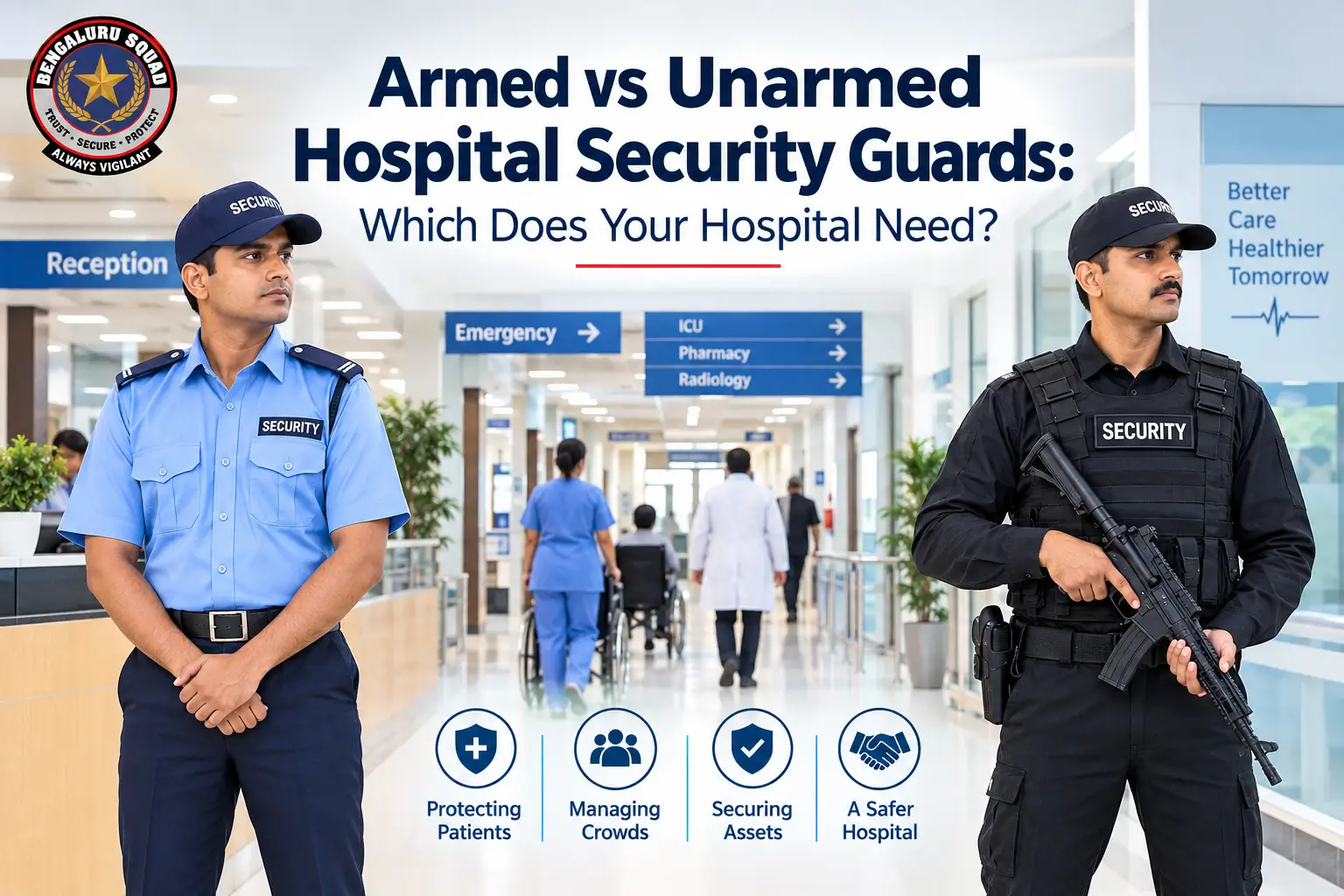
Walk into any hospital in India today and you'll notice something that wasn't as common ten years ago,a visible security presence at the entrance, in the emergency ward, and near the pharmacy counter. Hospitals have quietly become one of the toughest places to secure. You have grieving families, high-value equipment, drug storage, newborns, and sometimes angry mobs, all under one roof. So it's no surprise that hospital administrators are asking a very practical question: should we hire armed or unarmed hospital security guards?
It's not a one-size-fits-all answer, and honestly, most hospitals end up using a mix of both. This guide breaks down exactly what each type of hospital security guard does, where they fit, and how to decide what your facility actually needs.
A few years ago, hospital security meant a watchman checking visitor passes. That's changed. Reports of assaults on doctors and nurses, disputes over medical bills, infant safety concerns, and theft of medicines and equipment have pushed hospitals to treat security as a core operational need, not an afterthought.
A hospital isn't like an office or a warehouse. It runs 24x7, has restricted zones like the ICU and OT, and deals with the public at their most emotional and unpredictable. This is exactly why hospital security guard deployment needs more thought than just placing a person at the gate.
Before comparing armed and unarmed options, it helps to understand the job itself. A hospital security officer typically handles:
Most of this work doesn't need a weapon. It needs patience, quick judgment, and the ability to de-escalate a tense situation without making it worse. That's an important point to keep in mind as we go further.
Unarmed guards make up the bulk of hospital security teams, and for good reason.
Where They Fit Best
Advantages
Where They Fall Short
Unarmed guards aren't equipped to handle armed intruders, organised theft attempts, or serious threats to VIP patients. That's where armed personnel come in.
Armed guards are less common in general hospital settings but become necessary in specific scenarios.
Where They Fit Best
Advantages
Where They Fall Short
Armed guards require a valid arms license, specialised training, and stricter background verification which naturally makes them costlier. They're also not meant to be stationed at every corner of a hospital; overuse can create unease among patients rather than confidence.
| Factor | Unarmed Guards | Armed Guards |
|---|---|---|
| Best for | Wards, OPD, visitor management | Cash counters, pharmacy, VIP wards |
| Cost | Lower | Higher |
| Training focus | Conflict handling, patrolling | Firearm handling, threat response |
| Visitor perception | Reassuring, approachable | Necessary but should be limited |
| Legal requirement | PSARA registration | PSARA + valid arms license |
Every hospital is different, so instead of picking one type of guard outright, weigh these points:
In most cases, the right answer is a blend - unarmed hospital security officers handling day-to-day visitor and ward management, with armed guards positioned only at high-risk points like the pharmacy store or cash office.
This part often gets overlooked. In India, any hospital security company must be registered under the Private Security Agencies Regulation Act (PSARA), 2005. Armed guards additionally need a valid arms license, and the hospital should confirm this documentation before deployment, not after.
A few things worth checking with any hospital security company you hire:
Skipping this due diligence is one of the most common mistakes hospitals make when hiring security.
A good hospital security company doesn't just send over a headcount of guards. It starts with a proper site assessment looking at entry and exit points, restricted zones, footfall patterns, and any past security incidents. Based on that, guard deployment is planned by shift, by zone, and by risk level.
For example, a typical deployment plan might place unarmed guards at the main entrance, OPD, and general wards, while an armed guard or gunman is posted near the cash counter or pharmacy during business hours. Night shifts often need additional patrolling staff since footfall drops but risk doesn't.
This is where working with an experienced hospital security company makes a real difference. Ad-hoc staffing without a proper risk assessment usually leaves gaps exactly where they matter most.
At Bengaluru Squad, hospital security is planned around this exact armed-unarmed balance. As an ISO 9001:2015 and ISO 45001:2018 certified, PSARA-registered security agency with over 18 years in the field, the team runs a proper site evaluation before recommending guard strength or type not the other way around.
Every hospital security officer deployed goes through background verification, and armed personnel are supplied only with valid firearm licenses in place. With over 1200 trained guards and experience across corporate, industrial, and hospitality security, the team understands that a hospital needs a different tone of security than a factory or an office - calmer, more attentive, and ready to de-escalate rather than confront.
There's no universal answer to armed vs unarmed hospital security guards, it depends on your hospital's location, patient profile, cash handling, and past incidents. What matters more than the choice itself is working with a hospital security company that actually assesses your risk before recommending a plan, rather than pushing a standard package.
If you're reassessing your hospital's security setup, start with an honest risk audit. That one step usually makes the armed vs unarmed decision a lot clearer.
Bengaluru Squad © All Rights Reserved - 2026
 Download Brochure

